

Sound Familiar?

Manual Action Allocation?
Having to allocate fire safety actions manually, which is time-consuming, prone to errors, and can lead to delays in addressing critical issues.
Data Scattering?
Fire safety data scattered across various documents and systems, making it difficult to get a consolidated view of compliance statuses.
Lack of Real-Time Monitoring?
The inability to monitor fire safety compliance in real-time, making it challenging to track performance and respond promptly to potential risks.
Reporting Challenges?
Difficulty in generating accurate and timely fire safety compliance reports.
; ?>)

How Can True Compliance Help?
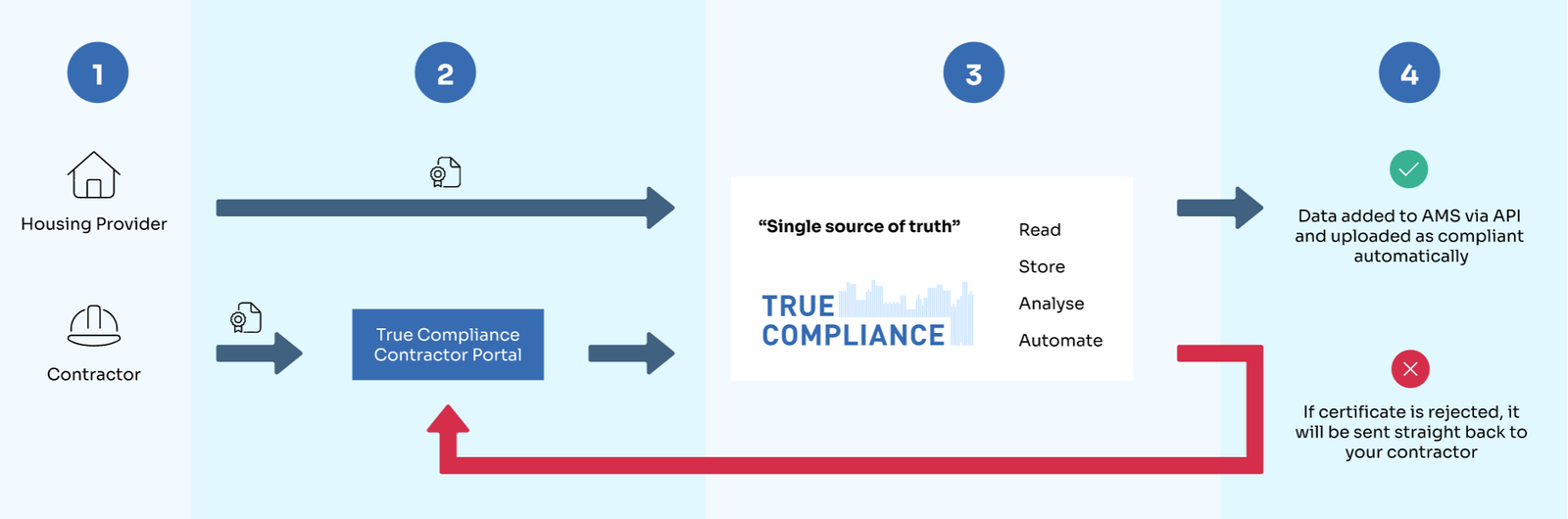
- Automatic Action Allocation: Eliminates manual processes, reduces the risk of errors, and ensures swift responses to critical issues.
- Centralised Data: Providing a consolidated view of compliance statuses for easy access and management.
- Real-Time Monitoring: True Compliance allows for continuous tracking of fire safety compliance, enabling quick response to potential risks and issues as they arise.
- Real-Time Reports: True Compliance simplifies reporting by providing comprehensive and accurate fire safety compliance reports, ensuring timely and efficient regulatory reporting and audit preparation.
Key Features
Document Gatekeeping
True Compliance ensures the integrity of your Fire Risk Assessment (FRA) documents. It verifies that each document is accurate, associated with the correct property, and up-to-date. This gatekeeping function eliminates the risk of relying on outdated or incorrect information.
Automated Action Allocation
True Compliance streamlines the process of managing FRA actions. It automatically assigns individual actions to the right team member, contractor, or department based on predefined criteria. This feature ensures that each action is promptly addressed, reducing response times and improving compliance.
Comprehensive Reporting
True Compliance provides real-time insights into your fire compliance status through intuitive dashboards and dedicated reporting tools. These features allow you to monitor progress, identify areas of concern, and track compliance performance against set targets or Key Performance Indicators (KPIs).
Programme of Works Creation
True Compliance simplifies the process of creating a programme of works based on your FRA findings. After completing an assessment, True Compliance allows you to seamlessly record refresh information and automatically calculate next due dates. This flexibility empowers you to efficiently schedule maintenance and actions, ensuring ongoing safety for your properties. True Compliance adapts to your needs, making programme creation a streamlined and intuitive process.
Trusted in partnership with housing organisations across the UK












Fire Safety FAQ's
Yes, you can store fire safety documents on the True Compliance system. Our tools will automatically extract information about the expiration dates of your compliance documents and inform you of the pertinent expiration and renewal dates. Your documents will be stored against the relevant property to ensure that they are easily accessible in the event of an emergency, an audit or an investigation.
Yes, our system is cloud based which enables it to be well-supported through updates and ongoing support to ensure that it stays up to date with the latest fire safety regulations.
True Compliance helps landlords and property agents to stay up-to-date and in-the-know regarding all of the compliance matters relating to fire safety by ensuring that all of your documents are securely and safely stored. The automatic reminders will ensure that you never fall behind in your fire compliance, making sure you keep your tenants and properties safe.
Smart Action Management is a feature in True Compliance that streamlines the handling and tracking of Fire Risk Assessments (FRAs). It automates the process of identifying, allocating, prioritising, and managing actions resulting from FRAs to ensure timely resolution.
Landlords are legally obligated to follow fire safety requirements and have the evidence to prove the regulations are being adhered to. Landlords and freehold owners of residential buildings have a legal responsibility to ensure a fire risk assessment is carried out. All fire risks and hazards must be identified and reduced as far as possible.
Landlords must make sure that the properties meet the relevant and up to date fire safety standards. The landlord must also inform the tenant of what to do in an emergency and to make sure emergency evacuation procedure plans are available.
FED stands for fire evacuation drill, a simulation that teaches people how to safely evacuate in the event of a fire incident. The FED that your building requires will depend upon the type of building, such as how many flights of stairs there are and where the exits are located. The main purpose of the FED is to ensure that people can react and stay safe in the event of a real fire emergency.
Broadly speaking there are five key steps that make up a fire safety risk assessment in the UK.
- Identify the fire hazards.
- Identify people at risk.
- Evaluate, remove or reduce the risks.
- Record your assessment findings, provide training and prepare an emergency plan.
- Review and update the fire risk assessment regularly.
In the context of fire safety PEEP stands for Personal Emergency Evacuation Plan, and is a document that states how people will be evacuated when they have difficulty responding to the fire alarm unaided.
A fire safety notice is generally issued by fire safety offices from the local Fire and Rescue Authority. They are issued in circumstances where the standard of fire safety measures are inadequate.